A girth flange is a large, circular flange that connects major sections of pressure equipment. Unlike a standard pipe flange that connects a pipe to a valve or fitting, a girth flange joins large-diameter vessel sections, heat exchanger channels, or pipeline spools.
Knowing when to use one is key for design, maintenance, and cost. This guide explains the main uses for girth flanges.
Table of Contents
What is a Girth Flange?
Think of a girth flange as a giant bolted clamp. It creates a seal between two large cylindrical sections. Its primary jobs are to:
- Contain pressure.
- Allow for complete disassembly for internal access.
- Provide a structurally sound connection.
They are custom-designed for specific pressure and diameter, unlike standard, off-the-shelf pipe flanges.
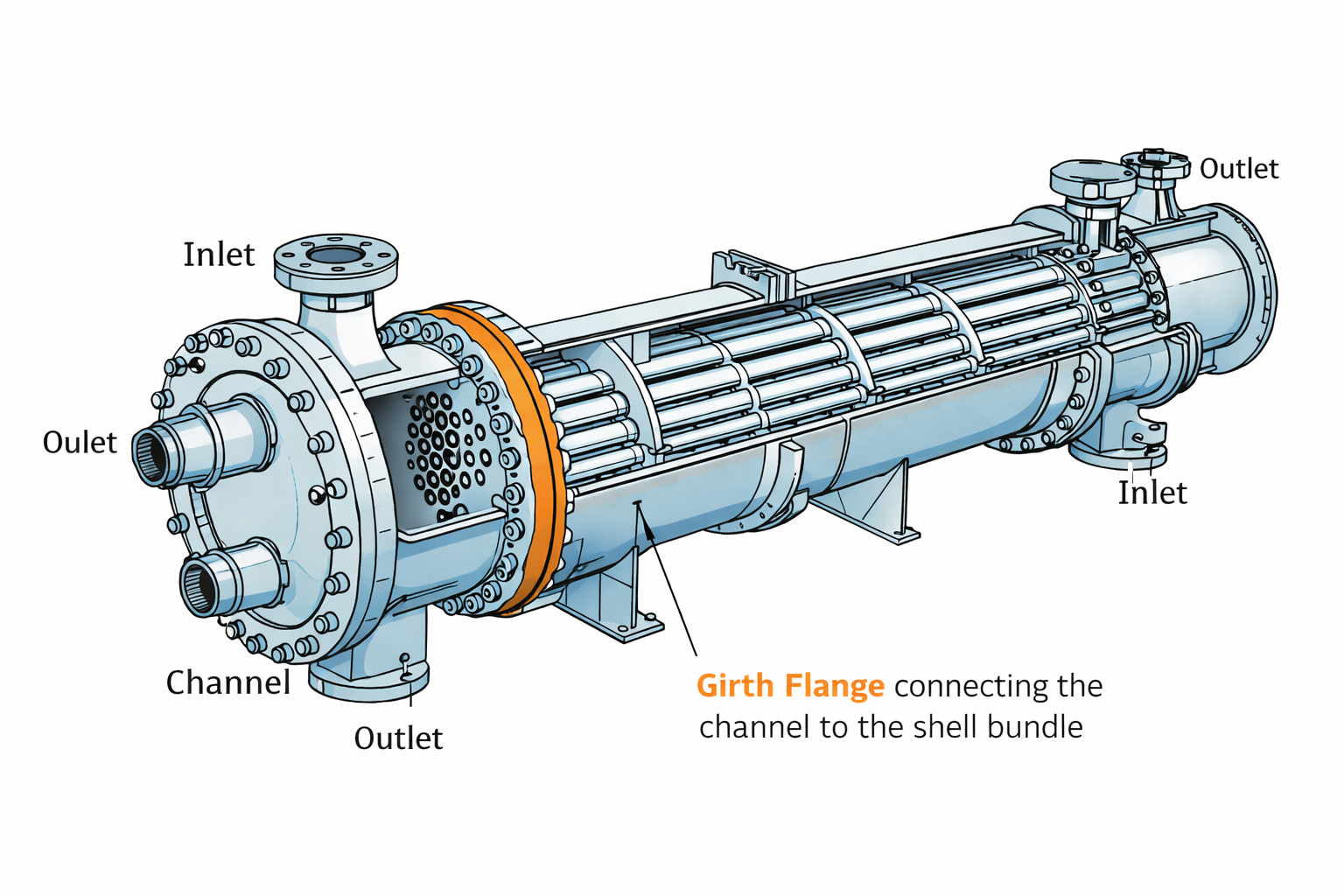
Primary Applications for Girth Flanges
1. Shell and Tube Heat Exchangers
This is the most classic application. A girth flange connects the shell to the channel or rear head.
- Why it’s used: It allows the entire tube bundle to be pulled out for inspection, cleaning, or repair. A permanent weld here would make maintenance impossible.
- Key point: The flange must handle system pressure and the forces from the pass partition plates inside the channel.
2. Pressure Vessels and Storage Tanks
Girth flanges are used to connect:
- Vessel shells to heads (dished ends).
- Multiple shell courses in tall, field-erected tanks.
- Nozzle connections for very large manways or instrument openings.
- Why it’s used: It enables fabrication in smaller sections for transport, followed by field assembly. It also provides access for internal work.
3. Large-Diameter Piping and Pipelines
For pipes above approximately 24 inches (where standard ASME B16.47 flanges become extremely heavy and costly), a girth weld is typical. However, a girth flange is used when:
- Future Disassembly is Needed: At a connection that may need to be opened later, like before a river crossing or at a plant boundary.
- Specialty Equipment Connections: To connect the pipeline to a pig launcher/receiver, a large filter skid, or other modular equipment.
- Emergency Repair Strategy: As a planned point where a section could be replaced if damaged.
4. Scraper Launchers/Receivers (Pigging Systems)
The closure on a pig launcher or receiver is essentially a large blind flange, which is a type of girth flange.
- Why it’s used: It must be opened frequently to insert or retrieve the pig (pipeline cleaning or inspection device). It must be a secure, pressure-containing closure that is also bolted for easy access.
Comparison: Girth Flange vs. Standard Pipe Flange
This table shows the core differences.
| Feature | Girth Flange | Standard Pipe Flange (e.g., ASME B16.5) |
|---|---|---|
| Purpose | Connects vessel/equipment sections or very large pipes. | Connects pipe to valve, pump, fitting, or another pipe. |
| Sizing | Custom-designed to vessel/pipe OD and pressure. | Standardized by Nominal Pipe Size (NPS) and pressure class. |
| Assembly | Often involves aligning and welding a flange ring to the shell. | Usually welded neck, slip-on, or threaded to a pipe end. |
| Cost | High (custom fabrication). | Relatively lower (standardized manufacturing). |
| Main Driver | Internal Access and major component assembly. | Connectivity within a piping system. |
Key Design and Selection Considerations
Specifying a girth flange involves more than just diameter and pressure.
1. Flange Face Type:
- Raised Face (RF): Common for general service with spiral-wound gaskets.
- Ring-Type Joint (RTJ): Used for very high-pressure or critical service (e.g., wellhead equipment). Provides a metal-to-metal seal.
- Flat Face (FF): Used when mating with a cast iron or flat-faced component.
2. Gasket Selection:
The gasket must be suitable for the flange face, fluid, temperature, and pressure. Common choices are spiral-wound (RF) or RTJ ring gaskets. Gasket selection is critical to prevent leaks.
3. Bolting Strategy:
- Large girth flanges need many bolts. The sequence for tightening (torquing) is critical.
- A cross-bolting pattern is used to compress the gasket evenly without warping the flange.
- For critical service, controlled bolt tightening (hydraulic tensioning) may be specified.
4. Material Selection:
The flange material must match the vessel or pipe material to ensure compatible welding and similar thermal expansion. Common materials are carbon steel (SA-105), stainless steel (SA-182), or low-temperature carbon steel.
Note: For More about Flanges Checkout Texas Flange
Advantages and Disadvantages of Using a Girth Flange
Advantages:
- Full Access: Enables maintenance and inspection of internals.
- Structural Integrity: Provides a strong, engineered connection point.
- Fabrication Flexibility: Allows building large equipment in modules.
- Leak Detection: The bolted joint can be monitored for leaks more easily than a buried weld.
Disadvantages:
- Cost: More expensive than a girth weld due to machining, bolts, and gaskets.
- Weight: Adds significant weight to the assembly.
- Leak Potential: Any bolted joint is a potential leak point, unlike a weld.
- Space: Requires radial clearance for bolt installation and tightening.
When to Choose a Girth Weld Instead
A girth weld is a permanent, welded connection. Choose it over a girth flange when:
- The joint will never need to be opened for the life of the equipment.
- You need to minimize potential leak points (e.g., for hazardous fluids).
- Weight and cost savings are a major priority.
- There is no requirement for internal access at that location.
Frequently Asked Questions (FAQs)
1. What is the difference between a girth flange and a blind flange?
A blind flange is a solid disk used to close off a pipe or vessel opening. A girth flange is a connecting flange with a bore. The large closure on a vessel head is often a blind flange that acts as a girth flange.
2. Can a standard pipe flange be used as a girth flange?
Generally, no. Standard flanges are designed for pipe-end connections with specific hub dimensions. Girth flanges are typically “ring-type” or “loose-type” designed to be welded to the specific OD of a vessel or pipe spool.
3. How are girth flanges installed?
The flange ring is aligned to the vessel or pipe section and then attached, usually by a full-penetration weld around its hub (for weld-neck type) or to the outside (for loose-type). Proper alignment before welding is critical.
4. What causes girth flange leaks, and how are they fixed?
Leaks are caused by uneven bolt torque, damaged flange faces, incorrect gasket, or thermal stress. Fixing it requires safely depressurizing the system, loosening bolts, inspecting faces, replacing the gasket, and re-torquing bolts in the correct sequence.
5. Are girth flanges used in offshore platforms?
Yes, extensively. They are used on separators, heat exchangers, and large pipeline riser connections where modular construction and maintenance access are essential.
6. How do I specify a girth flange?
You need to provide the design pressure and temperature, inside diameter, material specification, facing type, and applicable design code (e.g., ASME Section VIII, Div. 1, Appendix 2). Refer to detailed guides for girth flange dimensions for more specifics.
7. Is a girth flange a “major” weld connection?
Yes. In inspection and quality assurance terms, the welds attaching a girth flange are critical. They often require full penetration, 100% non-destructive testing (NDT), and welder qualification records.
Conclusion
Use a girth flange when you need a secure, openable connection between large pressure-containing sections. Its main purpose is to allow access.
The decision to use one balances maintenance needs against higher cost and leak potential. For permanent, sealed connections where access isn’t required, a girth weld is often the better choice.
For heat exchangers, large vessels, and strategic pipeline locations, the girth flange is an indispensable engineering solution. Proper specification, fabrication, and assembly are key to its reliable performance.